

By the time the casters of Igun Eronmwon were producing the brass plaques that lined the walls of the Oba's palace in the sixteenth century, sculptors in what is now Nigeria had been working in clay, terracotta, copper, brass, and bronze for nearly three thousand years. The land between the Niger and the Benue rivers — and the forests south of the Niger, and the high plateaus of the centre — held some of the longest, most sophisticated sculptural traditions on earth. Three of them, in particular, anchor the record.
The first is the Nok culture, which flourished on the Jos Plateau from roughly 1500 BCE to 300 CE. Its potters and iron-smelters produced terracotta human and animal figures more than a thousand years before Christ — among the oldest known sculptures of human beings made anywhere in sub-Saharan Africa.
The second is Igbo-Ukwu, in what is now Anambra State in southeastern Nigeria, which by the ninth century CE was producing cast-bronze ceremonial vessels of such technical complexity that, when they were first dated by radiocarbon in the 1960s, the dates were initially disbelieved. Specialists could not accept that this work had been made in West Africa that early. The dates have since been confirmed many times over.
The third is Ife, the ancient and holy city of the Yoruba, where between roughly the eleventh and fifteenth centuries — the same centuries Europe spent building Notre-Dame and Chartres — sculptors created naturalistic portrait heads in copper, brass, and terracotta whose technical and artistic refinement is unmatched in the medieval world. Ife is the city Yoruba cosmology identifies as the place where Oduduwa created the earth itself.
These three traditions are not stops on a single line. They were separate civilisations, separated by hundreds of miles, by hundreds of years, by language, by religion, by political form. What connects them is the land they sat on — what is now Nigeria — and the fact that each one, on its own terms, was producing work of an order that should have made the names Nok, Igbo-Ukwu, and Ife as familiar to the world as Carthage, Knossos, and Ravenna.
Nok: the first Nigerian sculptors
c. 1500 BCE — c. 300 CE — Jos Plateau, central Nigeria
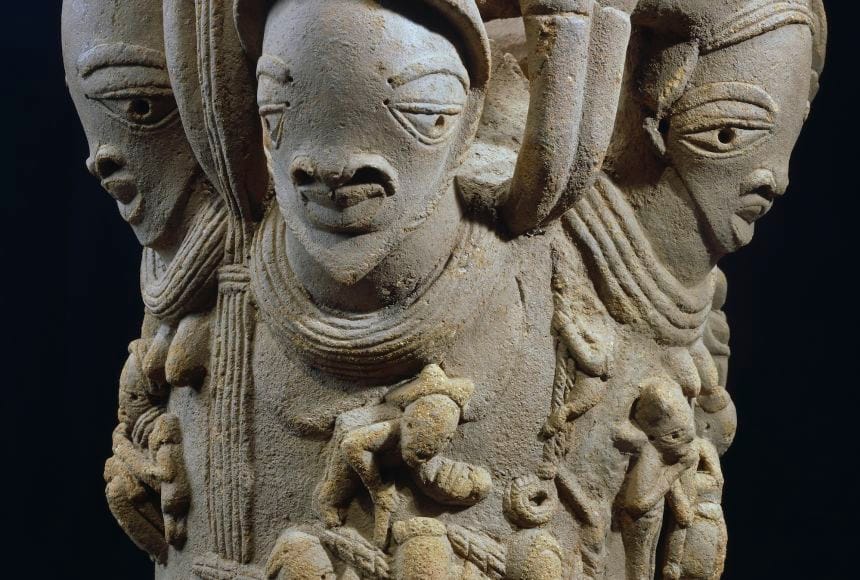
In 1928, on a tin-mining concession near a small village called Nok in present-day Kaduna State, a co-owner of the mine named Colonel Dent Young was working through alluvial gravel when the workers turned up a small terracotta head. It came out of the ground at a depth of about seven metres. Young saved it and sent it to the museum in Jos.
Fifteen years later, in 1943, a clerk at another mine in the same general region found a larger terracotta head and took it home, where it served for a year as a successful scarecrow in his yam field. When the British colonial archaeologist Bernard Fagg heard about the head, he recognised that it resembled a piece he had seen years earlier and that neither piece matched any other known African artefact. Fagg spent the next two decades travelling across central Nigeria, gathering similar fragments — pieces that had been turning up in tin-mining gravel, in farm fields, on rocky hillsides — and slowly assembling the outline of an entire civilisation that the colonial record had no name for. He named it after the village where Young had found the first head.
The Nok culture, as we now understand it, occupied a region of central Nigeria covering roughly 78,000 square kilometres — a stretch of the Benue Plateau between the Niger and Benue rivers, in what are now Kaduna, Plateau, Nasarawa, and Federal Capital Territory. The earliest dates from the Frankfurt Nok Project, which has been excavating systematically since 2005, push the start of the culture back to around 1500 BCE. The end is harder to fix; production of figurines seems to have ceased by around 300 CE, though the people themselves did not vanish — they were absorbed into successor cultures whose descendants still live on the same land.
What the Nok built, in addition to settled villages with stone house bases and elaborate funerary practices, was a tradition of terracotta sculpture without obvious precedent in the region. The figures were modelled in coarse local clay mixed with gravel for strength, built up by coiling — the same method potters use — and then fired in open-air kilns covered with grass and twigs. The largest pieces are nearly life-size human figures, carefully vented through the eyes and mouth so that expanding gases during firing would not crack the clay. The smaller pieces include heads, complete figures, animals, and objects whose function is still being debated.
Two features identify a Nok piece on sight. The first is the eyes. They are typically rendered as elongated triangles or ovals with a horizontal slit pierced through the middle — eyes that look not at the viewer but past them, downward, with the kind of gravity reserved in many African sculptural traditions for the dead. The second is the head itself. Nok figures are radically top-heavy: the head can constitute a full third of the entire figure's height, and is often elaborately ornamented with intricate hairstyles, headdresses, beaded necklaces, bangles, and what may be markers of social rank. Whatever the Nok believed about the head, they believed it loudly.
Recent excavations at sites like Janjala and Pangwari, run by Peter Breunig and the Frankfurt team, have established that the figurines were closely associated with burial sites — they were ritual objects, used in funerary practice and possibly as offerings to ancestors. They appear in association with iron-smelting furnaces, suggesting that the same communities that produced the sculpture were also among the earliest practitioners of iron technology in sub-Saharan Africa, with smelting dates as early as 280 BCE. A society that had figured out how to extract iron from ore had also figured out how to render the human form in clay with extraordinary specificity.
The Nok did not write. The Nok did not, as far as we know, build monumental architecture. They left behind, in vast numbers, sculptures of themselves — heads with the same elongated eyes and elaborate coiffures, bodies with the same proportions, postures of seated figures and standing figures and figures holding objects whose function we are still working to identify. This is one of the things art does that nothing else does. It tells us, three thousand years later, what these people thought a person looked like.
A society that had figured out how to extract iron from ore had also figured out how to render the human form in clay with extraordinary specificity.
The Nok are, in archaeological terms, contemporaries of the founding of the Roman Republic, the lifetime of the Buddha, the rise of Persia, and the building of the Great Wall of China. They sit, in time, where the rest of the Mediterranean and Asian classical world sits. The fact that their name is not commonly placed alongside those names is a problem of inherited curriculum, not a problem of historical fact. The work is older than most of the antiquities we routinely teach.
Igbo-Ukwu: the bronzes that should not have been possible
c. 9th–10th century CE — Anambra State, southeastern Nigeria
In 1938, in a town called Igbo-Ukwu in southeastern Nigeria, a man named Isaiah Anozie was digging a water cistern in his compound when his shovel struck metal. He pulled out an object he could not immediately identify — a heavily corroded ornamental piece of cast bronze. He kept digging and found more. By the time he stopped, he had recovered hundreds of fragments. He distributed some among his neighbours and kept the rest. The find made local news. Eventually it reached the colonial administration, and from there it reached the small community of European archaeologists working in West Africa.
Two decades passed before anyone arrived to investigate properly. In 1959, the British archaeologist Thurstan Shaw, then teaching at University College Ibadan, was invited by the Nigerian government to excavate. He returned in 1964 for a second campaign. Across the two seasons, working at three sites — labelled Igbo Isaiah, Igbo Richard, and Igbo Jonah, after the men whose compounds they sat in — Shaw and his team recovered more than seven hundred bronze and copper objects, along with iron tools, pottery, ivory, textiles, and roughly 165,000 glass and carnelian beads.
The radiocarbon dates came back. The objects were from the ninth or tenth century CE. They were five hundred years older than the Benin Bronzes. They were among the earliest known bronze castings anywhere in sub-Saharan Africa.
The dates were initially controversial. Several scholars argued they could not be right — that the technical sophistication of the work was inconsistent with what was known about West African metallurgy in the ninth century. Subsequent analyses have confirmed Shaw's chronology repeatedly. The dates are correct. The bronzes really are that old.
What Shaw had found was not a single workshop or a single tomb but the material remains of a complete ritual society. The three sites told three different stories. Igbo Isaiah was a shrine — what was once a temple, called an obu, that had collapsed. The objects there had been deliberately deposited, perhaps as a ritual sealing. Igbo Richard was a burial chamber, lined with wooden planks and mats, containing the remains of a high-status individual seated upright in regalia. Igbo Jonah was a disposal pit, where ritual objects from a destroyed shrine had been carefully buried after the shrine fell out of use.
Most scholars now read the Igbo-Ukwu material as the ritual paraphernalia of an early Eze Nri — the priest-king of the Nri kingdom, the Igbo religious polity whose successors continue to function in southeastern Nigeria today. The Nri king was not a political ruler in the conventional sense. He was a sacred figure whose authority was theological and ritual rather than military, who exercised influence across a network of Igbo communities through the legitimacy of his connection to the divine. The objects from Igbo-Ukwu — the staff heads, the pendants, the ceremonial vessels — were the material technology of that authority.
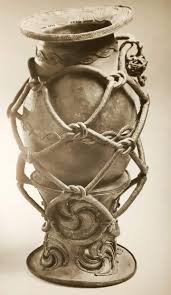
The technical achievement is what stops everyone who looks at it carefully. The casters at Igbo-Ukwu used the lost-wax method — the same process that produces the Benin Bronzes, the Ife heads, and most of the great cast-metal traditions of West Africa — but they pushed it to limits that European foundries, working in much wealthier states with industrial supplies of metal, did not match for centuries. The Roped Pot on a Stand, perhaps the most famous single object from the site, is a hollow bronze vessel cast in a single pour, around which appears to be tied a network of knotted rope. The rope is not real. It is also bronze. The casters made a wax model of a pot, then made a wax model of a knotted rope wrapped around it, and cast both together — the pot and its illusory rope — as a single object, with the rope passing in and out of the pot's surface in places where physically a real rope could not. It is a virtuoso demonstration of what lost-wax can be made to do in the hands of a master.
The pieces are covered in surface ornament of staggering density: tiny insects — flies, grasshoppers, beetles — crawl across the surface of vessels in delicate three-dimensional relief; coiled patterns of geometric ornament cover the bodies of staff heads; cast figures of leopards and snails decorate ceremonial cups. Some of the pendants are face plaques carved with the ichi pattern — the radiating linear scarification still used among Igbo title-holding men today as a marker of initiation, indicating that the people who made these objects belonged to the same lineage of cultural practice that present-day Igbo communities continue to perform.
And the materials had travelled. Chemical analysis of the copper, lead, and tin used in the bronzes points to sources at Abakaliki — about a hundred kilometres from Igbo-Ukwu — and to mining regions on the Jos Plateau. The carnelian beads recovered at the site came from much further away, with parallels in Egyptian and trans-Saharan trade goods of the same period. Igbo-Ukwu was not isolated. It was a node in a long-distance trade network that connected the southeastern Nigerian forests with the Sahara and beyond.
What this means is straightforward. By the ninth century, in the rainforests south of the Niger, there was a society organised around a sacred kingship, with established trade links across half a continent, producing some of the most technically refined cast metalwork the human race has ever made. None of this required outside influence. The Igbo of the Nri kingdom developed their bronze tradition, like the Nok before them and the Ife after them, on their own ground, on their own terms, under their own gods.
Ife: the city where the world was made
c. 11th–15th century CE — southwestern Nigeria
Yoruba cosmology begins at Ile-Ife. According to the tradition, in the time before there was land, the supreme god Olodumare instructed Obatala to descend to the waters and create the earth. Obatala drank too much palm wine on the journey and fell into a stupor. Oduduwa took the materials of creation from him — a snail's shell of sand, a five-toed cockerel, a palm nut — descended on a chain from the realm of the gods, and poured the sand on the primordial waters. The cockerel scattered the sand. The mound rose. The palm nut sprouted into a great tree with sixteen branches, representing the original sixteen Yoruba clans. The first city built on the new earth was Ife. Every Yoruba city, every Yoruba kingdom, every Yoruba dynasty, traces its origin back to it.
This is not a metaphor with which Yoruba people decorate their identity. It is, for the practising Yoruba religion that survives today across Nigeria, Benin, Togo, the Caribbean, and Brazil, a literal account of the origin of the earth. Ife is not a museum-piece city. It is a sacred site. The current Ooni of Ife — the spiritual head of the Yoruba people — sits on a throne whose lineage runs in unbroken succession from Oduduwa himself.
On the soil of this sacred city, between roughly the eleventh and fifteenth centuries of the common era, sculptors developed one of the great art forms of the medieval world.
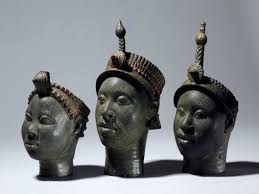
The Ife heads — there are about thirty known examples in copper alloy, plus dozens more in terracotta — are unlike anything else in the African sculptural record before or since. Where Nok terracottas are stylised and Igbo-Ukwu bronzes are densely ornamented, the Ife heads are naturalistic to a degree that startles people who encounter them for the first time. Each head appears to be a portrait of a particular individual. The proportions are exact. The lips are full and softly modelled. The cheekbones are precisely placed. The eyes are alert. Many of the heads are covered in fine vertical striations from forehead to chin — what scholars believe are stylised representations of facial scarification used by the Yoruba royal lineage. Some of the heads have small holes around the hairline and along the jaw, suggesting that they were originally fitted with hair or beards of real human hair, and possibly with crowns of real coral beads, for use in royal funerary ceremonies.
The most famous of the heads, often called the Ife Head, was found in 1938 by chance during construction work at the Wunmonije Compound in Ile-Ife — a site near the royal palace where, in a single discovery, eighteen heads in copper and brass were unearthed at once. The Ife Head is now in the British Museum, where it featured in the BBC and British Museum project A History of the World in 100 Objects. It is roughly life-size, cast hollow in nearly pure copper, and so anatomically accurate that when it first surfaced in the European art world, the dominant assumption was that it had to have been imported from somewhere else.
It was not imported from anywhere. It was made in Ife, by Ife sculptors, working under the patronage of an Ife king.
Yoruba tradition identifies many of the most famous Ife works as having been produced under Oba Obalufon II, who is remembered today as the patron deity of Yoruba brass casters, weavers, and royal regalia-makers. Obalufon's portrait — a serene, life-size copper face mask, roughly the size of a real human face, with delicate striations across the surface and exquisite anatomical balance — is one of the most beautiful objects to survive from the medieval African world. It is now held at the National Museum of Ife. The face is real. Whoever made it had looked at a living person, taken the measure of a king's face, and translated it into copper with no margin for error.
The technique was lost-wax casting, the same general method used at Igbo-Ukwu and later at Benin. But the Ife casters had to develop techniques specific to the human face: thin-walled hollow casts, fine surface finishing, the detailed rendering of nostrils and irises and lips, the correct relationship between forehead and brow and cheekbone and chin. Comparable naturalism in cast metal portraiture in Europe waited for the Italian Renaissance — Donatello's bust of Niccolò da Uzzano, often cited as the moment European bronze portraiture became fully naturalistic, was made in the 1430s, several decades after the latest Ife heads were probably produced.
The Ife heads sit in this same period. The two traditions never met. They are not derivative of each other. They are, in their separate places, working the same problem — how to translate a living face into permanent metal, with all of its specificity intact — and arriving at extraordinary, comparable solutions. There is nothing about the achievement at Ife that requires an external explanation. It is one of the things human beings can do when they have the materials, the technique, the patron, and the will to do it. Ife had all four.
The why of the heads matters as much as the how. In Yoruba thought, the head — ori — is the seat of ase, the spiritual force that animates a person, governs their destiny, and guides them through life. The head is sacred. To make a portrait of someone's head is to make a dwelling for their ase, a place where their spiritual presence can continue to be honoured after their body is gone. Most scholars now believe the Ife heads were used in second burials — funerary ceremonies held some time after a king's death, in which the head, perhaps fitted with hair and crown and ceremonial fabrics, served as the deceased monarch's continuing presence among the living. This is the same logic that produces the commemorative heads on the royal altars of Benin two centuries later. The Ife casters were the first to formalise it.
What runs through three thousand years
Three civilisations. Three different peoples. Three different cosmologies. Three different time periods, separated by hundreds of years and hundreds of kilometres. There is no single thread that ties Nok to Igbo-Ukwu to Ife in any direct way — they are not parent and child, not master and student, not centre and periphery. They are independent achievements, each one growing out of the specific conditions of its own community.
But certain things do recur, and the recurrence tells us something.
All three traditions privilege the head. Nok figures are top-heavy because the head matters most. Ife sculptures are nearly all portrait heads because the head holds ase. Igbo-Ukwu pendants depict faces with the ichi marks because the marked face is the face of the initiated person. The body, in all three traditions, is the vehicle. The head is the dwelling. This is a continuity in West African philosophical thought, present in Yoruba religion today, present in Igbo religion today, and visible in Nok sculpture from a millennium and a half before either of those religions had the names they have now.
All three traditions are funerary, or partially so. Nok figures cluster around burial sites. Igbo-Ukwu objects sit in the tomb of an Eze Nri and in the buried shrine that served his rituals. Ife heads are made for second burials of kings. The objects are not, primarily, decorative. They are made to do work in the world of the dead, and through that work, to continue the obligations between the living and their ancestors.
All three traditions are technically advanced beyond what the colonial-era scholarship was willing to credit. Nok terracottas were made by people who had also developed early iron-smelting. Igbo-Ukwu bronzes were cast at a level of complexity that European foundries did not match for centuries. Ife heads were cast in nearly pure copper — a far more difficult metal to work with than brass — at thin-walled accuracy that should have made the European art world reconsider its entire framework when Frobenius first published photographs of them. Each tradition, on its own, demonstrates that the technical sophistication of West African societies was a fact of West Africa long before any European arrived to misunderstand it.
And all three traditions were made by communities whose direct descendants are still here. The Nok are not lost. Their descendants live in the same region of central Nigeria, and the cultural patterns visible in Nok sculpture — the elongated eye, the elaborate coiffure, the funerary use of figurines — survive in transformed forms in the cultures that succeeded them. The Igbo of Igbo-Ukwu are still the Igbo. The Eze Nri institution is still recognised in Anambra State. The ichi facial marks still appear at certain Igbo title-taking ceremonies. The Yoruba of Ife are still the Yoruba, and the Ooni of Ife still occupies the throne, and the festivals that the Ife heads were probably made for are still observed in cycles that have not stopped. The work is ancient. The peoples are not.
The Benin Bronzes, in this longer perspective, do not stand alone. They sit at the most recent end of a continuous tradition of West African sculptural mastery that runs back three thousand years.
The Benin Bronzes, in this longer perspective, do not stand alone. They sit at the most recent end of a continuous tradition of West African sculptural mastery that runs back three thousand years through Ife, through Igbo-Ukwu, through Nok, and out into the deeper past from which all three of them emerged. The Edo did not invent the lost-wax technique they used; oral tradition records that it came south to them from Ife. The Ife casters did not invent it either; the technique was already known elsewhere in West Africa for centuries before they refined it for naturalistic portraiture. The line is long. It is older than most things the world is taught to call ancient.
A short note on what the colonial record refused to see
It would be possible to write this article without mentioning Leo Frobenius at all. It would also be possible to write it as if Frobenius mattered most. Neither would be honest. He was a real figure in the modern history of how this work was first introduced to European audiences, and his role is worth a few paragraphs — no more — for what it reveals about how the colonial archive learned to handle what it could not categorise.
Frobenius was a German ethnographer who arrived in Ile-Ife on 29 November 1910, on the fourth of his German Inner-Africa Research Expeditions. He spent three weeks in the city. He had heard of an extraordinary bronze head said to depict the sea god Olokun, and he persuaded Yoruba elders to let him see it. When the head was unwrapped, he wrote,
"Before us stood a head of marvellous beauty, wonderfully cast in antique bronze, true to life, encrusted with a patina of glorious dark green… very finely chased, indeed like the finest Roman examples."
He was not wrong about the quality of the work. He was wrong about everything else. He could not, he wrote, accept that the head was "negro in countenance" — by which he meant that the realism, the proportion, the technical mastery, were so far beyond what his Eurocentric framework permitted Africans to have produced that the head must have been made by someone else. He proposed that the Yoruba were the surviving remnant of refugees from Atlantis — the lost continent of Plato's myth — that Olokun was a Yoruba memory of the Greek Poseidon, and that the head was a Mediterranean artefact stranded by historical drift on a West African coast. He published these claims across twelve volumes between 1921 and 1928.
This was not, by the standards of his time, an unusual conclusion. It was the standard conclusion. When Europeans encountered African artistic achievement that did not fit the framework they had built — a framework in which Africans were assumed to be incapable of refined art, complex cosmology, or sustained civilisation — the framework was rarely revised. What was revised was the African origin of the work. The Great Zimbabwe stone city, when colonial-era archaeologists first encountered it, was attributed to the Phoenicians, or to the Queen of Sheba, or to early Portuguese travellers. The Benin Bronzes, when they reached London in 1897, were attributed by some to Portuguese teachers. The Ife heads were attributed by Frobenius to Atlantis. None of these attributions had any evidence. All of them had the same logic: the work was real, the achievement was real, and therefore the makers had to be revised.
The Atlantis theory was abandoned, formally, by 1948. By the time Bernard Fagg was excavating the Nok terracottas and Thurstan Shaw was excavating the Igbo-Ukwu bronzes, the European art-historical establishment had quietly stopped invoking Atlantis. What it had not done — what, in many parts of the world, it has still not done — is recover and circulate the names of the actual sculptural traditions of the African continent with anything like the attention given to Greek pottery or Roman bronze. The replacement for the Atlantis story has not been the right story. It has often been silence.
This is one of the things Africa Rebirth exists to address.


