
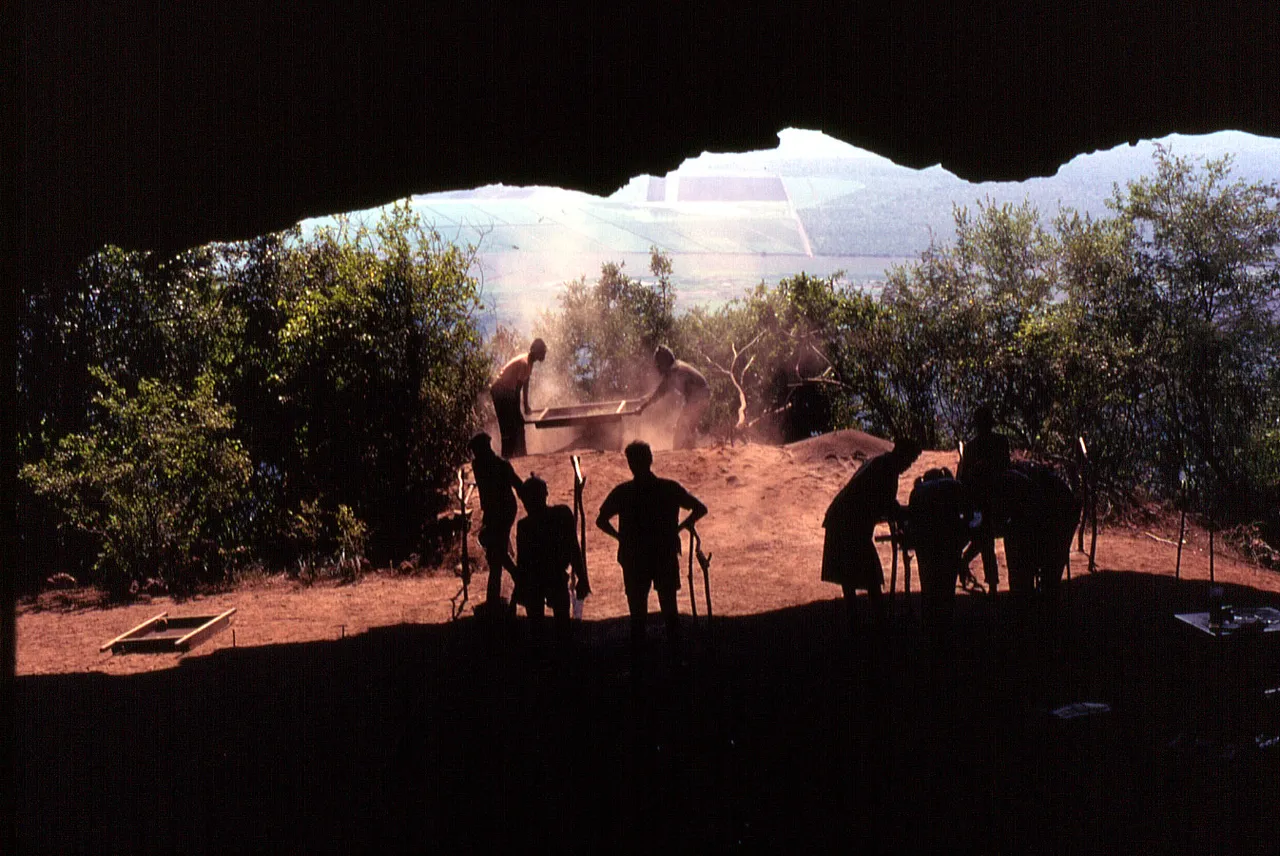
In the 1970s, archaeologist Peter Beaumont was working through the layers of Border Cave, a rock shelter on the western scarp of the Lebombo Mountains, on the border between South Africa and Eswatini. Among the stone tools and bone fragments he found something small and strange: the fibula of a baboon, about eight centimetres long, with 29 notches cut deliberately along one edge.
Two dozen radiocarbon dates place the bone at around 43,000 years old. That makes it older than farming, older than the first villages, and older than writing by well over 35,000 years. It is widely described as the oldest known mathematical artefact on Earth. The question that has followed it ever since is a simple one: what was being counted?
One mark for one thing
The system behind the bone is the oldest one there is. Each notch stands for one thing. One night, one animal, one day. There are no symbols here and no numbers in the sense we use the word. The count is the marks themselves, a one-to-one match between a cut in bone and a thing in the world. Every number system that came later, from tally sticks to smartphones, is built on that same idea.
Close study of the cuts shows they were not all made at once. The notches differ slightly in shape, which suggests different cutting edges were used, perhaps at different times. Beaumont himself thought this pointed to marks made during rituals, added to over time, rather than a single counting session. That detail matters, because it is a reminder that the bone was a tool someone lived with, not an object made in an afternoon.
Twenty-nine, and the moon
The number 29 is what catches the eye. A lunar month, the time it takes the moon to go from full to full, lasts about 29.5 days. The archaeologist Alexander Marshack proposed that the bone was a lunar phase counter, a way of tracking the nights until the moon came round again. The Universal Book of Mathematics took the idea a step further: if the bone tracked the moon, it may also have tracked menstrual cycles, "in which case African women may have been the first mathematicians."
That reading has a living echo. This way of making tallies is still used by San communities in Namibia, where the same simple method keeps track of days and events. The bone may be 43,000 years old, but the habit it records never died out.
What the bone cannot tell us
Honesty demands the other side of the story. The bone is broken at one end, so 29 may only be a minimum. The original count could have been higher, and if the total was never 29 at all, the neat match with the lunar month weakens. There is also no technique that can tell us what prehistoric marks were for. Other notched bones exist that are 80,000 years old, and for those it is not even clear whether the marks are functional or decorative.
So the careful claim is this: the marks are deliberate, and they are mathematical in nature. Whether they tracked the moon, a hunt, or something else entirely is a reasoned guess, not a settled fact. The bone proves that someone, 43,000 years ago, could hold a count in their head and fix it in a lasting form. It does not prove what they were counting.
The count that never stopped
The Lebombo bone did not start a school or a written tradition. Writing would not arrive for tens of thousands of years. But the idea it carries never went away. Tallying became tokens pressed into clay, tokens became writing, and writing became arithmetic. About 20,000 years later, on the shores of Lake Edward in what is now the Democratic Republic of Congo, someone picked up another bone and went further: the Ishango bone carries its notches in grouped columns that some read as doubling and prime numbers, a debate of its own.
Most of us were taught that mathematics began in Greece or Mesopotamia. The Lebombo bone says otherwise. It says the first mathematician we know of worked in southern Africa, tens of thousands of years before either civilisation existed, with a baboon bone and a sharp stone. That is what survives. What was counted is lost, and perhaps that is the point: the oldest maths on Earth is a question as much as an answer.
Sources: Wikipedia, "Lebombo bone"; Wolfram MathWorld, "Lebombo Bone"; d'Errico et al., Proceedings of the National Academy of Sciences (2012).


