
In the heart of southern Mali, the Bamana (or Bambara) people once practised rituals that went far beyond simple ceremony. These were transformative acts, communal moments of profound significance that bound individuals to their communities and connected the living to the supernatural. At the centre of this spiritual and social stucture were two interrelated societies: Jo and Gwan. Through their rituals, sculptures and initiation ceremonies, these societies shaped what it meant to be Bamana.
Yet, like much of Africa's indigenous knowledge systems, the story of Jo and Gwan has been obscured by colonialisation and modern neglect. Still, what remains—especially the elaborate sculptures displayed in art exhibitions in the West—tells us something vital about the West African peoples that came before us.
The Bamana and Their Empires
To understand Jo and Gwan, one must first understand the Bamana themselves. The Bamana are a Mandé ethnic group whose roots stretch back thousands of years to the broader Mandé migrations that gave rise to some of West Africa's most powerful states. By the 13th century, the Bamana had emerged as a royal group within the Mandinka people, playing significant roles in the Mali Empire. But it was in the 18th century that the Bamana truly came into their own.
In 1712, Mamari Kulubali transformed a tòn (a traditional youth association) into a military force. Assuming the leadership title of bitòn, he established the Sègou Empire with its capital at Ségou-Koro along the Niger River. What began as an egalitarian organisation of young men who had undergone circumcision initiation together became the foundation of a state. Through military prowess and strategic alliances, Bitòn expanded Bamana control across the central Sudan region, conquering Macina, Djénné and even exacting tribute from Timbuktu.
The Bamana resisted Islam for centuries, maintaining their traditional polytheistic beliefs even as Muslim communities grew powerful around them. This resistance was so notable that some scholars argue that the name ‘Bamana’ or ‘Bambara’ came to mean ‘unbeliever’. It was not until the mid-19th century, when the Toucouleur conqueror El Hadj Umar Tall launched his jihad and conquered Ségou in 1861, that Islamic conversion began in earnest. Even then, many Bamana retained elements of their ancestral practices, creating a syncretic tradition that persists today.
It was within this context of resistance and cultural assertion that Jo and Gwan flourished. These were not merely religious institutions but frameworks for understanding the cosmos, social order and human purpose.
The Jo Society
Much like the Bwami of DRC, Jo was an initiation society that structured the transition from youth to adulthood for Bamana men—and sometimes women. Historically, all young Bamana men in southern Mali communities, particularly around the towns of Bougouni and Dioïla, were required to become members of Jo. The society operated on a seven-year cycle, during which initiates underwent rigorous training and instruction in Bamana philosophy, moral conduct and social responsibilities.
The aim of Jo was to use the spiritual power of the society's ritual objects and the dedication pledged in members' solemn oaths to assure the harmony of society. Beyond learning practical skills, Jo members were to internalise the values that would make them proper members of the community. Initiates learnt about the importance of knowledge and secrecy, the challenges posed by sorcery, the dual nature of humankind, the necessity of hard labour in producing crops and the realities of day-to-day survival.
Jo was part of a broader system of initiation societies among the Bamana known collectively as Dyow or Jow. Traditionally, six societies existed in sequence: N'tomo, Komo, Nama, Kono, Chi Wara and Kore. A Bamana man was expected to pass through all six to be considered fully rounded, with complete insight into ancestral teachings. Jo, however, held a unique position because of its inclusive nature. Unlike the other societies which were exclusively male, Jo welcomed both men and women.
Central to Jo's practices were the sculptures known as jomògòniw, large figurative works that embodied Bamana ideals of beauty, character and action. These sculptures were not decorative objects but sacred entities. They were kept in shrines and brought out only during annual ceremonies, typically at the beginning of the rainy season when elder Jo members offered sacrifices to strengthen them. The sculptures would be removed from their shrines, cleaned, oiled and decorated with cloth and beads before being set up in the village square in groups. The gatherings always featured a mother and child figure, usually accompanied by a similarly attired male figure and several other lesser figures.
The mother and child were seated in positions of honour, wearing and holding tokens of physical and supernatural power such as knives, lances and amulet-studded hats. These symbols carried a lot of significance. For instance, the amulet-laden hat was conventionally associated with the powers of male hunters, yet when worn by a female figure, it suggested a woman of extraordinary abilities who transcended ordinary gender roles. When viewed as a whole, these sculptural ensembles were the embodiment of Bamana ideals and behaviour.
Another category of sculpture associated with Jo were the nyeleni or jonyeleni figures. These were smaller, standing depictions of young women used in Jo initiation performances that took place every seven years. The figures represented ideals of youthful feminine beauty and were carried by newly initiated young men during itinerant performances from village to village. They were placed on display in dance areas or held by dancers and were jokingly referred to as the young men's "girlfriends". This underscored the serious concern of these initiates to marry—a qualification for achieving adult status in Bamana society. The nyeleni figures were believed to protect the initiates from harm and served as paradigms of beauty and well-being.
The Gwan Society
Closely affiliated with Jo was the Gwan society. In fact, some scholars refer to Gwan as a sect of Jo. Whatever the case, the two groups had different purposes. While Jo focused broadly on social cohesion and the passage into adulthood, Gwan focused on helping women who had difficulty conceiving and bearing children. In traditional Bamana society, as in many African cultures, childless marriages were a grave communal problem with serious repercussions.
Fertility, both human and agricultural, was understood as interconnected. The same forces that made the earth yield crops were believed to govern a woman's ability to conceive. Gwan addressed this connection directly through rituals, sculptures and sacrifices aimed at promoting reproductive health and ensuring the continuity of the lineage.
The sculptures associated with Gwan, called gwanyiriw, were similar in style to those of Jo but were even more elaborate. A typical Gwan ensemble could include up to seven figures, with a central mother-and-child figure surrounded by a father and several other adult male and female attendants. These figures illustrated both physical and moral beauty, a much-appreciated unification in Bamana culture.
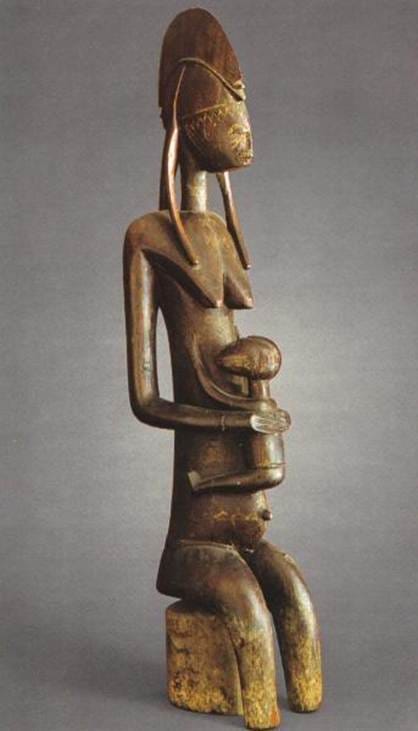
The Gwandusu figure. Source: African Art in the Cycle of Life
The most iconic of the Gwan sculptures is the gwandusu, often depicted as a seated woman holding a child. This figure represented not only a baby but the entire concept of birth and regeneration. She embodied the heroic mother—a woman of dignity, strength and extraordinary abilities. The gwandusu wore the symbols of power usually reserved for hunters and other prominent male figures, thereby making a deliberate statement about the nature of motherhood itself. In Bamana cosmology, bringing forth life was an act that required courage, supernatural power and resilience equal to that of any hunter of warrior.
Women with fertility problems would affiliate themselves with Gwan, making offerings at the shrines where the gwanyiriw were kept. Those who succeeded in bearing children would make extra sacrifices to Gwan, dedicate their children to the society and name them after the sculptures. The sculptures were enshrined and taken out only during annual ceremonies, when they were ritually cleansed and dressed in loincloths, head ties and beads contributed by the women of the village.
These annual rituals took place at the beginning of the rainy season—the time when the earth itself was being ‘fertilised’ by water. The ceremonies were directed not only at assuring the fertility of women but also the fertility of crops, acknowledging that the survival and prosperity of the community depended on both.
Carved from wood by skilled blacksmiths (numu), who occupied a sacred caste in Bamana society, the Bamana figures often incorporated organic materials and were imbued with spiritual power through repeated use in ritual. Radiocarbon analysis has suggested that some of the surviving Jo and Gwan sculptures may have originated as far back as the 15th to 17th centuries rather. This is extraordinary for wooden sculptures, which typically do not survive long in the warm, moist climates of West Africa. Their preservation is largely due to the arid conditions of the Ségou and Bougouni regions, as well as the care with which they were ritually maintained.
Many of the ornaments and weapons depicted on Jo and Gwan figures are also found on terracotta sculptures from Mali that date from the 12th to 17th centuries, suggesting continuity in aesthetic and symbolic traditions across centuries and media.
Art as Philosophy
What distinguishes Jo and Gwan from many other African initiation societies is the central role that sculpture played in their rituals. To an uninitiated observer, a gwandusu might simply appear as a beautifully carved figure of a mother holding a child. But to those who had undergone the seven years of Jo initiation and who had been gradually introduced to the esoteric significance of the figures, every element—from the posture to the scars—carried specific philosophical and spiritual meaning.
The bodies of Jo and Gwan figures were generally rounded rather than angular, with fluid, organic transitions between limbs and torso. Their faces were thin and tapered, with large, heavy-lidded eyes, slender noses and sharply projecting lips. The exaggerations of the human form emphasised power and presence. The long, massive torsos with wide, arching shoulders conveyed stability and strength.
Importantly, whilst the roles of men and women were distinct in Bamana society, they were considered equally important. The male companion figures in Jo and Gwan ensembles held lances and wore the hats of warriors, symbolising protection and authority. The female figures, meanwhile, held infants and sometimes weapons, symbolising both nurturing and strength. Together, they represented the complementary forces necessary for communal survival.
For the Bamana, sculpture was not simply art but also a form of moral and spiritual instruction. Over the course of the initiation, jocew (advanced members of the association) would gradually reveal and explain the deeper significance of these powerful creations to newer initiates. In this way, knowledge was transmitted not through written texts or abstract doctrine but through material culture that could be seen, touched, ritually transformed and collectively experienced.
The Decline and Legacy of Jo and Gwan
By the late 19th century, the Bamana world was changing irrevocably. The Toucouleur conquest of 1861 had already dealt a severe blow to traditional Bamana political structures, and conversion to Islam accelerated. When the French colonised Mali in 1890, they imposed a new administrative order that undermined the authority of traditional institutions like Jo and Gwan. Missionaries, both Muslim and Christian, viewed the societies as "pagan" and actively worked to suppress them.
The sculptures that had once been sacred objects became curiosities for the international art market. In the late 1950s, a group of Jo and Gwan figures appeared on the European and American art markets. The uniqueness of these figures immediately captured the attention of collectors and scholars. Several were included in Robert Goldwater's landmark 1960 exhibition of Bamana art at the Museum of Primitive Art in New York, introducing them to a global audience but severing them from the ritual contexts that gave them meaning.
Today, iconic Bamana figures sit in the collections of major museums, including the Metropolitan Museum of Art in New York, which displays a group of Jo and Gwan sculptures that once belonged to Nelson A. Rockefeller. They are presented as masterpieces of African art, which they undoubtedly are, but stripped of their original functions as agents of initiation, fertility and communal cohesion.
In a few Bamana villages, the Jo and Gwan societies continue to function, though often in diminished form. Some communities still produce and display sculptures during annual rituals, maintaining a link to ancestral practices. Yet, the full seven-year cycle of initiation is rare, and the deep esoteric knowledge once transmitted through the societies has been fragmented by conversion, urbanisation and the pressures of modernity.
The significance of Jo and Gwan extends beyond the Bamana themselves. These societies offer a window into how African communities have historically understood fundamental questions about life, purpose, personhood and belonging. The sculptures, even if stripped from ceremonial pomp, still speak.