

In the town of Bonwire, in the forested heart of what is now Ghana, two brothers named Kuragu and Ameyaw watched a spider weaving its web. The spider was Anansi, the trickster, the keeper of all stories. The brothers studied the way the threads crossed and recrossed under the patient legs of the weaver, and they went home and tried to do the same with thread of their own. The cloth they made was beautiful enough to be presented to the chief, who presented it to the Asantehene Osei Tutu I, who declared it a royal art. They called it nwentoma — woven cloth. The name we know it by came later, from kɛntɛn, the Twi word for basket, in honour of the basket-weave that the brothers had borrowed from the spider.
That was sometime in the seventeenth century. Several hundred miles to the northeast, in the inland delta where the Niger River bends through Mali, women had already been doing something else with cloth for at least five centuries. They harvested cotton, spun it into thread that the men would weave into narrow strips, sewed those strips into a single panel, and then — here was the invention — they painted the cloth with mud. Specific mud, taken from specific ponds, fermented for months in clay jars until it was the right kind of black. They drew with it. The cloth fought back, drank the iron, and held the marks. Each pattern they painted meant something. The cloth was a sentence. Read in one direction it might be a proverb; in another, a warning; in another, a record of who the woman wearing it had become.
Across the continent, in towns and villages that had never heard of one another, women and men were doing some version of the same thing. In southwestern Nigeria, Yoruba women were dipping cloth in indigo so saturated that the deepest pieces took twenty-five separate dyings to achieve a blue that bordered on black. In the rainforests of the Kasai basin in central Africa, Kuba women were embroidering raffia panels with geometric patterns so mathematically intricate that, three centuries later, computer scientists would write papers about their fractal symmetries.
These textiles were not decoration. They were not ornament. They were not, primarily, fashion. They were ways of writing in societies that did not require an alphabet to compose meaning. They carried proverbs. They marked life passages. They named gods. They identified clans. They preserved the values a mother wanted her daughter to inherit. They were — and this is the part that matters — a literature.
Four cloths, four ways of speaking
Of the dozens of major textile traditions on the continent, four have travelled the furthest, lasted the longest, and developed the deepest grammars. Kente from Ghana. Bogolan from Mali. Adire from Nigeria. Kuba from the Democratic Republic of Congo. Each is a complete language. Each was developed under specific conditions by specific people for specific reasons. And each — though they have crossed centuries and been carried into living rooms and runways and graduation halls around the world — still holds inside it the original meaning the makers built into the cloth.
Kente — Ashanti and Ewe, Ghana
Cloth woven from proverbs
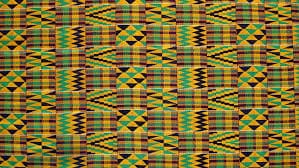
Kente is a strip cloth. The fundamental unit is a narrow band of cotton or silk, about four inches wide, woven on a horizontal loom with two pairs of heddles that allow the weaver to lift different combinations of warp threads to make complex patterns. A single garment is built from many of these strips, sewn edge to edge until they form a wide cloth large enough to drape around the body in the manner of a Roman toga.
The visible architecture is colour and pattern, and the meaning sits in both. Among the Ashanti, gold means royalty, wealth, and spiritual purity — the divinity of the kingdom itself. Green is renewal, fertility, and the richness of the land. Blue is the sky and the spiritual realm. Red is political passion, blood, sacrificial spirit. Black, perhaps the most layered of all, signifies maturation, intensified spiritual energy, and the ancestors. White is purification, festive occasions, and joy. None of these are choices a weaver makes lightly. A cloth woven for a coronation is not a cloth woven for a funeral, even if both occasions might call for the same shade.
But it is the patterns themselves that carry the deepest text. Each warp design has a name, and the names are taken from proverbs, historical events, queen mothers, and chiefs. AberewaBene, "a wise old man," symbolises wisdom and maturity. Owu nhye da — "death has no fixed date" — is a cloth that warns the wearer to live rightly because the end may come without warning. Nkum me fie na nkosu me aboten — "don't kill my house and then mourn for me in public" — is a cloth that names the duplicity of those who destroy in private and grieve performatively in public. Other patterns are named for stars, plants, animals, or the marks left on the body by particular kinds of leadership.
Historically, the most intricate kente cloths were reserved for the Asantehene himself. The king kept a special wardrobe attendant whose only job was to select, store, and repair the royal cloths. Some patterns could be worn only by the king. Others were limited to specific royal ranks. Even among lesser officials, it was considered a serious breach of etiquette to wear a finer cloth than your superior — the cloth was rank itself, and the rank was visible to anyone who could read.
What that means, in the language of the Ashanti, is that kente is sartorial scripture. The Asante anthropologist Kwasi Konadu has called it text in textile — a literature you wear, that announces who you are and what you believe before you have spoken a word.
Bogolan — Bambara and Mande peoples, Mali
Mud cloth, women's writing
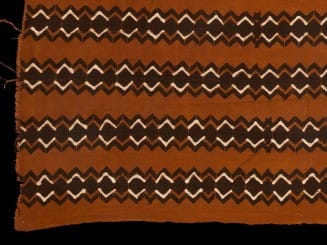
Bogolanfini — bogo, mud or earth; lan, with or by means of; fini, cloth — is one of the older textile traditions on the continent, with archaeological evidence of related techniques dating back to at least the twelfth century in the Beledougou region of central Mali. The fragility of cotton has erased most of the early record, but the practice has been continuous in the same villages for the better part of a millennium.
The labour is divided. Men plant and harvest the cotton, and weave the narrow strips on horizontal looms. The women take over from there. They sew the strips together to make a panel, soak the panel in a mordant solution made from the leaves of certain trees — n'gallama is the most common — which turns the cloth a saturated yellow. Then they paint. The brush is a piece of bamboo or a flat metal blade. The ink is fermented mud taken from specific ponds and aged in clay pots, sometimes for over a year, until the iron in it will react with the tannins in the n'gallama-soaked cloth. Wherever the mud touches, the cloth darkens to deep brown or black. The yellow background is then bleached with a caustic solution, leaving the painted areas dark against bright cream.
The patterns are coded. Zigzags speak of life's path and its inevitable turns. Spindles for weaving cloth — three parallel lines — symbolise wealth and luxury, because cloth is wealth. Crocodile motifs invoke Bambara mythology and the founding ancestors. Some patterns commemorate famous battles, including, in one well-documented case, a battle between a Malian warrior and a French colonial unit. Other patterns are protective: hunters wore bogolan tunics for ritual safety in the forest, and the cloth was believed to absorb the dangerous spiritual forces released during the most vulnerable transitions in a woman's life — the period preceding marriage, the period after childbirth, the period of recovery from illness.
These meanings were not casual. They were a code that only the women who had been initiated into the tradition could read. Mothers taught daughters. Apprenticeships lasted years. The patterns combined into sentences, the sentences into messages, and the woman who wore the cloth carried that message on her body for everyone in the village who could read.
Bogolan, in other words, was women's literature in a society that the colonial archive insisted had no writing. The cloth itself was the rebuttal.
Adire — Yoruba women, Nigeria
Indigo, and the goddess who blesses it
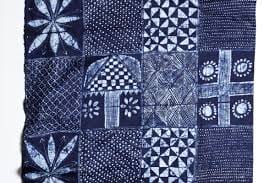
Adire is the indigo-resist cloth produced by Yoruba women in the southwestern cities of Abeokuta, Ibadan, and Osogbo. The name in Yoruba comes from adi, to tie, and re, to soak — tied and soaked, the original technique. By the early twentieth century, when imported European cotton shirting flooded West African markets, Yoruba women dyers turned that influx into an opportunity. They expanded the technique into a whole grammar of resist methods. Adire became one of the most artistically inventive women's industries on the continent, and the cities of Abeokuta and Ibadan became its capitals.
There are three foundational techniques. Adire oniko is raffia resist — the dyer ties hundreds of small pebbles, corn kernels, or seeds into the cloth with raffia, and after dyeing the small white circles emerge in patterns of moons, fields, scatters, and constellations. Adire alabere is stitch resist — the dyer stitches raffia thread into the cloth in deliberate patterns; once dyed and the threads removed, the design appears as a ghost line of white against the indigo. Adire eleko, the most demanding, is starch resist — the dyer hand-paints designs onto the cloth with a thick paste of cassava starch, lets it dry, then dyes the cloth. Where the paste sat, the indigo cannot penetrate. The starch is washed away, and the design emerges in pale outline against the deep blue.
The patterns of adire eleko are an entire iconography. A cloth might be divided into a grid of fifty-six squares, each one painted with a different motif — a hunchbacked bird, a writing slate, a plantain tree, the pillars of a town hall, a handbag, a spoon. The Ibadandun pattern — "Ibadan is sweet," or "Ibadan is good" — celebrates the city itself by depicting the alternating columns and spoons of Mapo Hall, the city's town hall. Another well-known pattern, Olokun, is named for the Yoruba goddess of the sea and depicts her domain in motifs of waves and fish. Sunbebe — "lifting up of the beads" — references the beaded waist ornaments that Yoruba women wear, identified with seduction, fertility, and adult femininity.
The trade was sacred as well as commercial. Indigo dyeing among the Yoruba was placed under the protection of Iya Mapo, an orisha — a deity of the Yoruba pantheon — whose particular dominion is over female trades. Iya Mapo is the deity of dyers, potters, oil pressers, soap makers — every craft historically practised by women. Every fourth day was her day of worship. To dye cloth was to participate in a tradition the goddess herself oversaw. Judith Byfield, the historian who wrote the definitive economic history of the Abeokuta dyers, titled her book The Bluest Hands — a reference to the way an experienced adire dyer's hands were permanently stained dark blue from years of work in the indigo vats. The hands were the proof of the trade, and the trade was an inheritance the women guarded jealously and passed down only through the family line.
What this meant in practice was that an entire economy was run by women, with its own theology, its own visual language, and its own pricing structure. The most experienced dyers — alaro — were business owners, employers, and respected community figures. Their cloth was sold across West Africa, and the wealth generated funded the education of their children and the influence of their guilds in colonial-era Yoruba society.
Kuba — the Kuba Kingdom, Democratic Republic of Congo
Geometry as collective memory
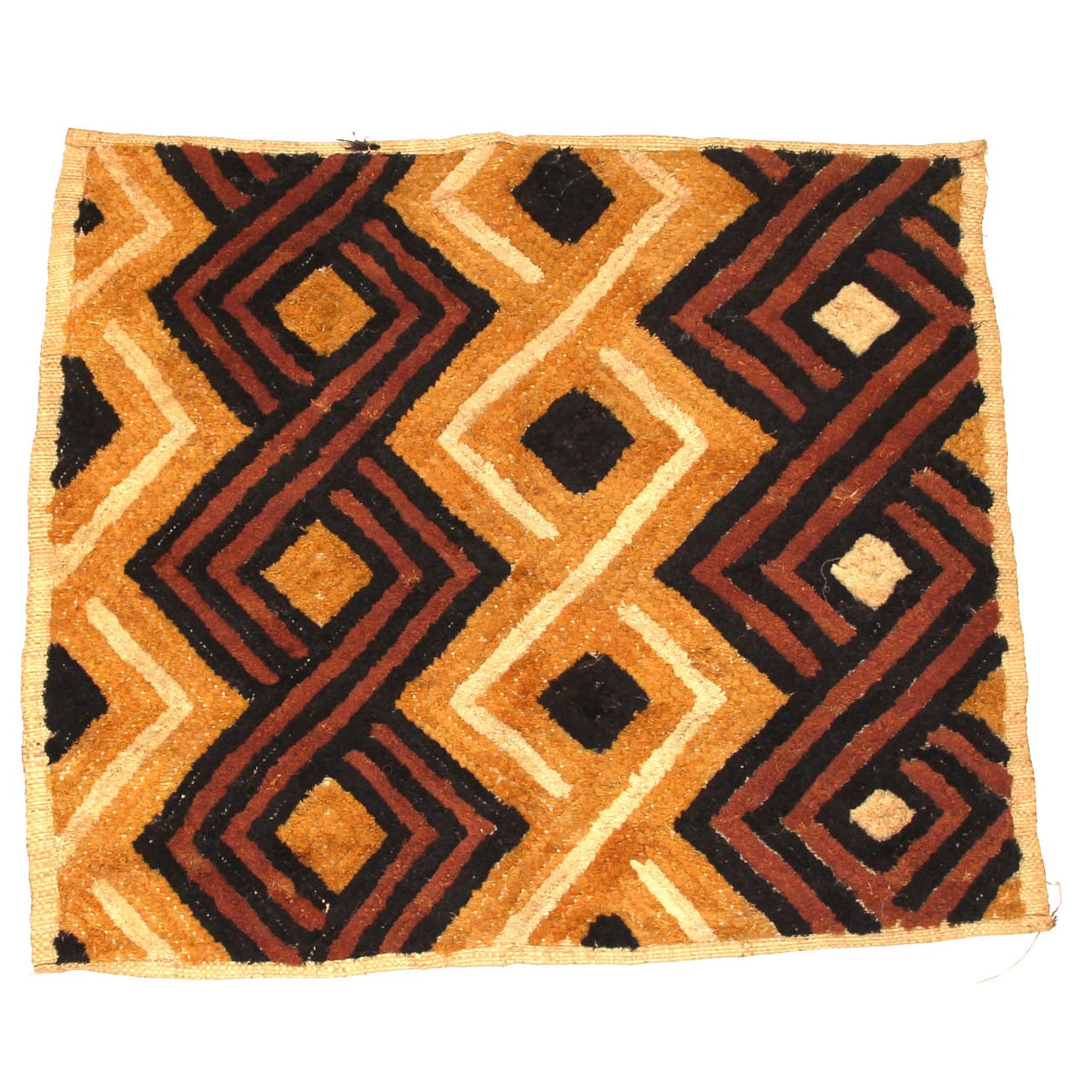
Far to the south and east, in the rainforests where the Sankuru, Lulua, and Kasai rivers meet in central Africa, the Kuba Kingdom flourished from roughly the seventeenth century onward as one of the most stable and centralised states in the region. The Kuba were known for many things — their carved wooden cups, their ceremonial royal portraits, their helmet masks — but their most extraordinary art form was a textile.
Kuba cloth is woven from the fibres of the raffia palm. The fronds are stripped, the fibres softened by hand-rubbing, then woven on a single-heddle inclined loom into small rectangular panels — usually no larger than a yard square, because the length of a single raffia fibre limits the size of the weave. The weaving is men's work. After that, the cloth passes to the women, and the women are the artists.
What they do to the cloth is the marvel. The most famous Kuba textiles, sometimes called Kasaï velvets or Shoowa cloths after the sub-group most associated with the technique, are made by drawing raffia threads through the woven base with a needle, then snipping the loops short with a small knife. Done thousands of times across a single panel, the result is a dense, plush surface that resembles velvet — a material the Kuba developed independently, with no relationship to the European fabric of the same name. Henri Matisse, who collected the cloths, called them mes velours — "my velvets." His apartment in Nice held many of them, and they sat on his walls as he worked.
The patterns are abstract — geometry without obvious figurative reference. Squares, diamonds, interlocking guilloche curves, broken lines, asymmetric rotations. To the casual eye they look like decoration. To a mathematician they look like something else entirely. The mathematician Donald Crowe, in a now-classic study, analysed the symmetry properties of Kuba designs and showed that of the seventeen possible mathematical ways a flat repeating pattern can be varied across a surface — the seventeen wallpaper groups, in technical terminology — the Kuba have explored twelve. A 2004 collaborative study by computer scientists and mathematicians at Concordia University in Montreal went further. They identified fractal symmetry in the panels: recursion, scaling, self-similarity, structures whose mathematical properties were not formally described in European mathematics until the late twentieth century.
The women who made these cloths were not consulting textbooks. They were drawing on a tradition of formal geometric exploration that had been refined over generations. Each ceremonial skirt — called ntshak when made for women, mapel for men — was assembled from many panels, each panel embroidered by a different woman within the same clan. The design was directed by the female head of the clan, who assigned panels to embroiderers based on their skill level and assembled the finished skirt. A single ntshak might be five or six metres long, sometimes nine. They were wrapped around the body three or four times for ceremonial wear.
What this means is that a Kuba ceremonial skirt is a collective composition. It is the work of a clan, not a single artist. It is mathematical thinking executed by women in the rainforest, generations before any European scholar gave that thinking a name. And it is communal in a way Western art history has been slow to grasp: the Kuba do not produce solitary masterpieces by individual geniuses. They produce collaborative compositions by groups of women working in lineage with their mothers and grandmothers, and the brilliance is the lineage itself.
What the cloth remembers
Lay these four traditions next to each other and certain throughlines emerge — patterns that recur across the continent and tell us something about how African societies have used textile to do work that other societies have asked of writing, of architecture, of law.
The first is that cloth is text. Kente patterns are proverbs. Bogolan patterns are coded sentences. Adire eleko grids are pictorial vocabularies. Kuba geometries are mathematical statements. In each tradition, the woman or the man wearing the cloth is making a public declaration in a language that others in the community can read. Africa was never the continent without writing. It was the continent where writing took forms — woven, dyed, embroidered, carved — that the Western definition of literacy failed to count.
The second is that cloth is gendered, and the gendering is decisive. Across all four traditions, women are the artists. Men weave the base cloth. Men plant the cotton, harvest the raffia, build the looms. But the artistic work — the painting, the dyeing, the stitching, the embroidery, the design — sits with the women. In Mali, mothers taught daughters bogolan. In Yorubaland, the trade of indigo dyeing was an inheritance passed within female family lines, blessed by a goddess of female trades. In the Kuba kingdom, the female head of clan directed the composition of every ceremonial skirt. These were not societies where women were pushed into a decorative side-room of culture. These were societies where women ran some of the most economically and spiritually significant artistic industries — and where the cultural memory was, to a substantial degree, a memory the women maintained.
The third is that cloth is collective. A Kuba ntshak is a clan composition. A Kente cloth is a proverb shared across the Ashanti nation. A Bogolan pattern carries a code that only the initiated women can read. None of these is the work of an isolated artist striving for personal expression. Each is the work of a tradition speaking through a maker who has been formed by it. The art and the community are not separable.
The fourth is that cloth marks the moments that matter. Bogolan is worn before marriage and after childbirth, when the spiritual stakes are highest. Adire wraps the women of Abeokuta and Ibadan at festivals, weddings, and naming ceremonies. Kente is the cloth of coronations and royal funerals. A Kuba ntshak is worn at burials, at initiations, at the elevation of a chief. The cloth is what we put on when we are passing from one state of being to another. It is the threshold — visible, wearable, walking with us across the moment of change.
Africa was never the continent without writing. It was the continent where writing took forms — woven, dyed, embroidered, carved — that the Western definition of literacy failed to count.
Still being woven today
Each of these traditions is alive. None of them ended. The forms have changed; the makers have changed; the markets have changed. But the cloth is still being made, and in many cases it is being made by direct descendants of the women and men who were making it three centuries ago.
In Bonwire, Ghana, the village where the Anansi-and-the-spider story is set, master weavers still produce kente on the same kind of horizontal loom Kuragu and Ameyaw used in the seventeenth century. The cloth is no longer reserved for royalty. It is worn at weddings, funerals, and naming ceremonies across Ghana, and it has become a global symbol of African pride and identity, draped over graduation gowns from Howard to Harvard. The patterns retain their names. Owu nhye da still means death has no fixed date. The proverb is still legible to anyone who has been taught to read it.
In Mali, the centre of bogolan production has shifted from village ateliers to artist-run studios in Bamako and Ségou. The Ndomo Centre in Ségou, founded by the artist Boubacar Doumbia, has become one of the most important sites for the transmission of the technique to younger generations. Bogolan is now a core symbol of Malian national identity, and Malian designers like Chris Seydou and Aboubakar Fofana have brought it onto international runways without hollowing out the codes. The mud is still fermented in clay jars. The patterns still mean what they meant.
In Nigeria, adire's twentieth-century decline — driven by synthetic dyes, mass-produced wax prints, and the disruption of traditional apprenticeships — has been substantially reversed by a single artist. Chief Nike Davies-Okundaye, born in 1951 in the small Yoruba town of Ogidi, is a fifth-generation textile artist. Her great-grandmother taught her adire when she was six years old, after the deaths of her mother and grandmother. She built her career on the tradition, and then she did something rarer: she gave it back. In 1983 she founded the Nike Centre for Art and Culture in Osogbo, which now offers free training in adire and other traditional Yoruba arts. Over the years she has trained more than three thousand Nigerians, and the centre has become one of the largest galleries on the continent.
Mama Nike, as she is known across Nigeria, has put the case for what she does in unmistakable terms in interviews over the years. Adire is a women's art. It was given to her by her great-grandmother, who learned it from her mother, who learned it from her mother. The patterns have not changed in form for generations because the meanings have not changed. To learn adire is to enter a lineage of Yoruba women who have been writing on cloth for centuries, and to teach adire is to keep that lineage open for the next generation of writers.
And in the rainforests of central Congo, Kuba women still embroider the panels that compose ceremonial skirts, still under the direction of the female head of the clan, still working in the same lineage their grandmothers worked in. The pieces sell now in galleries from Brussels to New York. The mathematicians are still studying them. The women have not stopped weaving.
What we are looking at, when we see kente at a graduation, or bogolan in a Lagos boutique, or adire on a runway in Paris, or Kuba cloth on a wall in a Brooklyn loft, is not an artefact. We are looking at one frame of a film that has been running for centuries — a film whose makers are still alive, still in the studio, still adding to the language. The cloth never stopped speaking. The question is whether we have learned to listen.


